The commands of Jesus are not just things disciples learn. They are practices disciples obey, repeat, and pass on.
Most Christians think discipleship means learning more — another study, another book, another class. But Jesus didn't send his disciples out to teach information. He told them to teach obedience.
That's what the commands of Christ actually are: a simple, practical obedience pathway for disciples and the churches they form together.
The Commands of Christ are simple practices Jesus gave his disciples to obey and pass on. In the CoVo pathway, they include: repent and believe, be baptized, receive the Holy Spirit, abide in the Word, love one another, practice the Lord's Supper, pray, ask God to work in power, give generously, worship, go make disciples, and gather regularly.
What Are the Commands of Christ?
The commands of Christ are core practices Jesus gave his disciples to obey and pass on — not just a set of ideas to understand, but a set of habits to live.
The commands of Jesus are not just things disciples learn. They are practices disciples obey, repeat, and pass on.
When Jesus gave the Great Commission, he didn't stop at "make disciples." He said to teach them "to observe all that I have commanded you" (Matthew 28:18-20). Observe — not memorize, not merely believe, but do. That single word turns discipleship from a knowledge project into a way of life.
These commands work at two levels at once. They train an individual disciple to follow Jesus personally, and they train a group of disciples to become a healthy church together — the same practices, scaled from one life to a whole community. CoVo uses the Commands of Christ tool at Obey.Tools to walk through all twelve in order.
Why Commands Matter in Disciple Making
Jesus didn't only say to teach information. He said to teach obedience. Obedience doesn't earn salvation — nothing you do buys what Jesus already paid for — but obedience is simply what following him actually looks like.
Here's the contrast worth remembering: information answers "What do I know?" Obedience asks, "What will I do because Jesus is Lord?"
New disciples need simple next steps, not a syllabus. Existing believers need repeatable rhythms, not more content they'll forget by next week. And churches need shared practices — without them, a group of Christians is just a collection of individuals who happen to meet in the same room and go home unchanged.
This is exactly where a lot of well-meaning discipleship quietly stalls. Someone reads a good book, attends a good class, even finishes a good study — and nothing in their actual week is different six months later. Commands close that gap, because they can't be merely understood. They can only be obeyed or not obeyed.
The commands of Christ are how making disciples actually becomes something lived, not just something believed — whether you just found a person of peace or you've been discipling someone for months.
The 12 Commands of Christ
The exact wording of command lists varies by training stream, but CoVo uses these 12 commands and practices as a simple pathway for disciples and churches.
 Repent & Believe
 Be Baptized
 Holy Spirit
 The Word of God
 Love One Another
 Lord's Supper
 Pray
Pray
 Signs & Wonders
 Generosity
 Worship
 Go…Make Disciples
 Gather
1. Repent & Believe
Mark 1:15
Disciples begin by turning from sin and trusting Jesus as King — and this isn't a one-time vocabulary word from a conversion moment. It becomes a rhythm of returning to Jesus again and again. Practice: confess what's true, turn from it, trust Jesus, obey what he says next.
2. Be Baptized
Matthew 28:19
Baptism is one of the first obedience steps for a new disciple, not a distant milestone reserved for the spiritually advanced. It identifies a believer with Jesus' death, burial, and resurrection. Practice: teach baptism simply, baptize new believers soon, and celebrate the new life it marks.
3. Holy Spirit
Acts 4:27-31
Disciples depend on the filling, power, boldness, guidance, and gifts of the Holy Spirit — disciple making was never meant to run on technique alone. Practice: ask for boldness before hard conversations, listen for the Spirit's leading, and pray specifically for power to witness.
4. The Word of God
John 8:31-32
Disciples abide in Jesus' words. Scripture gets read for obedience, not just information — the question after reading isn't "did I understand it," it's "what will I do about it." Practice: read a passage, retell it, obey it, share it with someone else.
5. Love One Another
John 15:12
Disciples are marked by love — real, costly, specific love, not a vague feeling. It looks like sacrificial care, quick forgiveness, service, honest truth-telling, and reconciliation. Practice: meet an actual need, forgive quickly, carry someone's burden this week.
6. Lord's Supper
Luke 22:19-20
Disciples remember Jesus' body and blood together, keeping the gospel visibly central rather than assumed in the background. Practice: remember what Jesus did, give thanks, examine your own life honestly, and proclaim his death until he returns.
7. Pray
Matthew 6:9
Disciples depend on the Father. Prayer isn't a religious formality that opens a meeting — it's the actual posture of dependence a disciple lives in. Practice: pray for one another, for the lost by name, for laborers, for boldness, for healing, and for daily needs.
8. Signs & Wonders
John 14:6-14
Disciples ask God to work in power — healing, deliverance, provision, breakthrough — always keeping Jesus, not the miracle itself, at the center of what's happening. Practice: pray for the sick boldly, ask God for more than you're comfortable asking for, and testify when he moves.
9. Generosity
Matthew 6:1-4
Disciples give because everything already belongs to God, not because giving buys favor. Generosity includes meeting real needs, supporting the mission, and stewarding resources for the kingdom rather than hoarding them. Practice: give secretly, care for a need you know about, support the mission financially.
10. Worship
Mark 12:28-34
Disciples love God with heart, soul, mind, and strength. Worship is bigger than singing — it's whole-life allegiance that shows up in ordinary Tuesday decisions, not just Sunday morning. Practice: praise specifically, practice gratitude, surrender something you're gripping tightly.
11. Go…Make Disciples
Matthew 28:18-20
Disciples are sent, not simply gathered. A disciple learns to make disciples the same way they were made into one — entrusting what they've received to others who can teach it again (2 Timothy 2:2). Practice: pray for people by name, share the gospel, baptize new believers, teach obedience, and train others to do the same thing you just did.
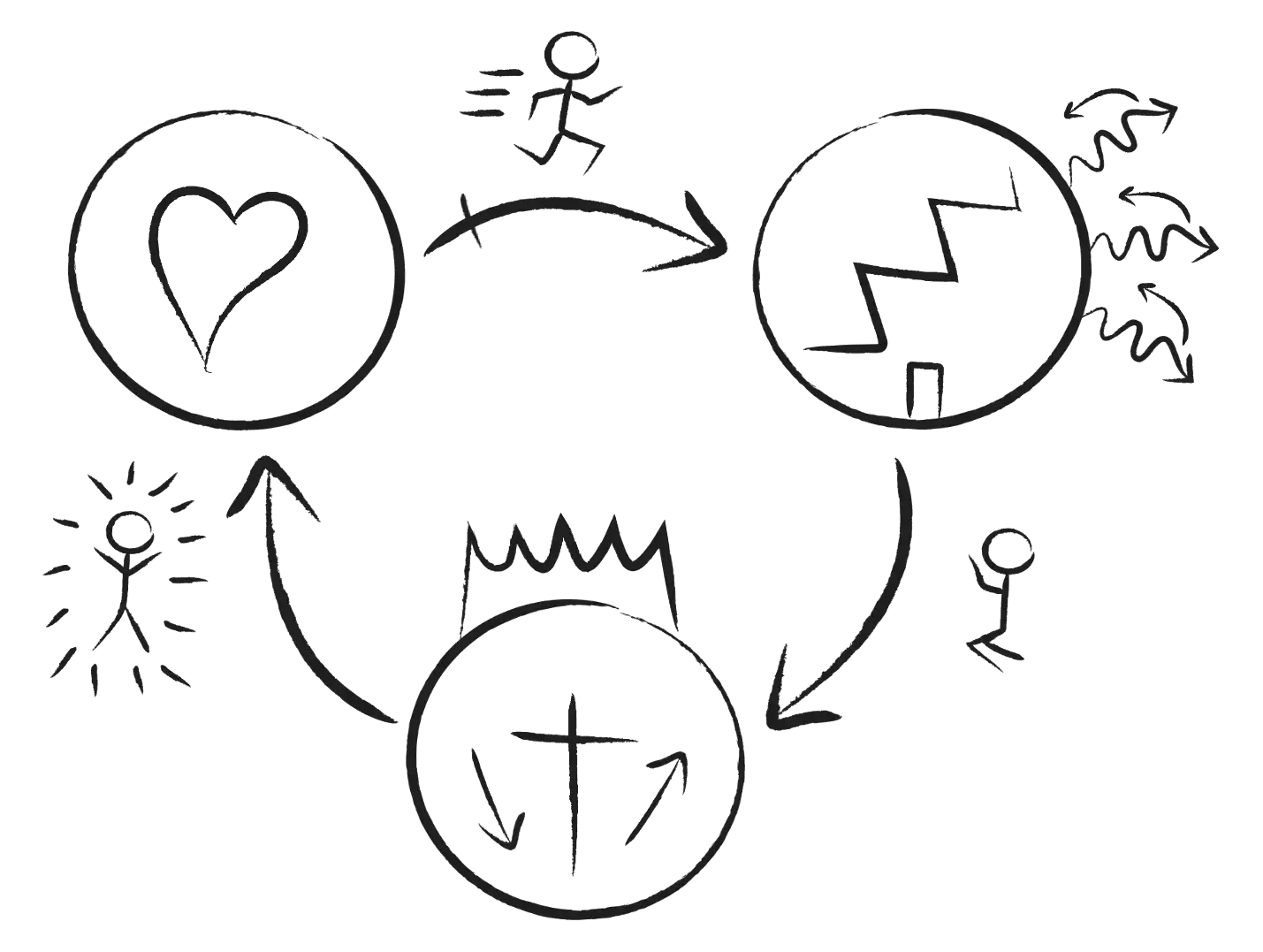
When it's time to actually explain the gospel, a simple 3 Circles gospel tool gives you something concrete to draw and say — Multiplying Disciples has a full walkthrough if you want to see it in more depth. See also how to share the gospel clearly for the fuller version of this practice.
12. Gather
Hebrews 10:24-25
Disciples gather regularly to stir one another up toward love and good works. Gathering isn't passive attendance — it's active participation. Practice: meet consistently, encourage each other by name, pray together, share what God's been doing, open Scripture, obey it, care for one another, and go.
How to Use the Commands of Christ With a New Disciple
Don't dump all 12 commands on someone in one sitting. Start with the next obedience step, not the whole list.
If someone just believed, that's your starting five: repent and believe, baptism, prayer, the Word, and sharing what just happened to them. The rest can come later, as rhythms rather than a syllabus to finish.
Ask simple questions after anything you read or discuss together:
- What does Jesus command here?
- What will you obey?
- Who will you share this with?
- Who can practice this with you?
A disciple is not mature because they finished a list. A disciple is growing because they are obeying Jesus and helping others obey him too.
Keep it simple and reproducible enough that discipling someone never turns into a curriculum nobody can pass on.
How the Commands of Christ Form a Simple Church
Disciple making naturally leads to gathering. A simple church forms when baptized disciples gather around Jesus and start practicing his commands together — not as individual homework, but as shared rhythms.
A simple church is a group of baptized disciples who gather around Jesus, obey his commands, practice the habits of the church, care for one another, and go make more disciples.
Church isn't mainly defined by a building, a brand, a sermon event, or an institution. It's a people under Jesus' lordship, practicing his way together — which means the 12 commands above aren't just personal disciplines, they're the actual curriculum of a healthy simple church, lived out communally instead of solo. That's exactly what Acts 2:41-47 describes: believers devoted together to teaching, fellowship, breaking bread, and prayer — the commands, functioning as the actual rhythm of a young church's week.
Once a group starts functioning this way, don't leave its health to guesswork. Use Church Assessment to identify which practices are weak and set real goals to strengthen them. If it's a whole established congregation practicing these same 12 commands together rather than a newly forming simple church, Church Waffle offers a similar whole-church assessment built on this same framework. For a practical walkthrough of getting one of these groups actually started, Multiplying Disciples has a good piece on how to start practicing church.
How to Practice the Commands as Habits and Rhythms
The commands should move from lesson to rhythm — from something you once heard explained to something your week is actually shaped around.
- A weekly gathering naturally includes prayer, the Word, obedience, testimony, and mission — not as an agenda, just as what happens when people who love Jesus meet regularly.
- The Lord's Supper becomes regular remembrance, not a rare special occasion.
- Generosity becomes shared care for actual needs you know about, not an abstract virtue.
- Going becomes a weekly rhythm of praying for names and sharing, not an annual outreach event.
- Worship becomes whole-life surrender, not a fifteen-minute segment.
If a command never becomes a practice, it stays stuck as an idea. Pick one weak spot from the list above and strengthen it this week — not all twelve at once.
Commands of Christ and Stories of Hope
The Commands of Christ train disciples to obey Jesus. Stories of Hope train disciples to share Scripture with lost friends and spiritually open people. Both belong in the same pathway, just at different points in it.
Stories often open the door — a simple Bible story someone can retell to a friend who isn't ready for a full gospel conversation yet. The commands train what happens once that door opens: obedience, and eventually, church rhythms. You don't need both running at full speed at once. Use whichever fits where the person in front of you actually is.
Common Mistakes When Teaching the Commands of Christ
Turning Commands Into Content Only
The goal isn't covering material. If someone can recite all 12 but hasn't obeyed one this month, nothing real has happened yet — you've taught a class, not made a disciple.
Moving Too Fast
New disciples need a simple, timely next step — not a syllabus dumped on them in week one. Slow down to their actual pace, even if it feels slower than you'd like.
Avoiding Hard Commands
Baptism, generosity, reconciliation, mission, and repentance can all require real courage. It's tempting to linger on prayer and worship and quietly skip the ones that cost something. Don't.
Separating Obedience From Grace
Obedience doesn't earn salvation — it's the fruit of already being saved, not the basis for it. Say this often enough that nobody mistakes the commands for a performance requirement.
Keeping the Commands Individualistic
Many of these commands were never meant to be practiced alone. Love, the Lord's Supper, gathering, and generosity all assume other people are actually present — a disciple practicing all twelve in isolation is missing half of what they're for.
A Simple 4-Week Plan to Start Practicing the Commands of Christ
Week 1: Repent, Believe, Be Baptized, and Pray
Focus on first obedience, prayer, and surrender. Get baptism scheduled if it hasn't happened yet, and start praying by name for the people in your oikos.
Week 2: The Word, Love One Another, and Sharing
Read Scripture together, obey what it says, love someone concretely with a real action, and share what Jesus is currently teaching you with at least one other person.
Week 3: Lord's Supper, Worship, and Generosity
Practice remembrance together, express real gratitude out loud, and give toward an actual need you already know about rather than a vague cause.
Week 4: Go Make Disciples and Gather
Pray for specific names, share the gospel with at least one of them, invite others in, and gather intentionally around Jesus instead of letting the group drift.
This is not a rigid curriculum. It's a starting rhythm — repeat it, adjust it, and keep going.
FAQ About the Commands of Christ
What are the Commands of Christ?
Core practices Jesus gave his disciples to obey and pass on — including repentance, baptism, the Spirit, Scripture, love, the Lord's Supper, prayer, signs and wonders, generosity, worship, mission, and gathering.
Are the Commands of Christ only for new believers?
No. New disciples start with the basics, but every command is a lifelong rhythm — mature believers and whole churches keep practicing all twelve, not just the first few.
How many commands of Christ are there?
There are many commands of Jesus scattered through the New Testament. CoVo uses this 12-command framework as a simple training pathway for disciples and churches, not a claim that it's the only possible list.
Why does CoVo use 12 commands or practices?
Because a short, memorable, reproducible list is more useful than an exhaustive one. Twelve is enough to be complete and small enough for someone to actually remember and pass on.
How do I teach the Commands of Christ to someone else?
Don't lecture — practice one command with them, then let them practice it with someone else. See how to disciple someone for the full training rhythm.
How do the Commands of Christ relate to simple church?
A simple church forms when a group of baptized disciples starts practicing these commands together instead of individually — the same twelve, lived out communally.
What is the difference between studying commands and obeying commands?
Studying answers what you know. Obeying answers what you actually did this week because Jesus is Lord. Only one of those changes a life.
Where should I start?
With whichever command you're currently neglecting the most. Pick one, practice it this week, and build from there.
Your Next Step
Pick one command from this list and actually practice it this week — not all twelve, just one.
If you're discipling someone, don't just explain the command to them. Practice it with them, the same way someone modeled it for you, and let them watch closely enough to hand it off again.
The commands of Christ were never meant to stay information. Take the Disciple Maker Next Step Finder to find your specific next step, and see CoVo's training resources for hands-on practice putting the commands of Christ into rhythm this week, not someday.